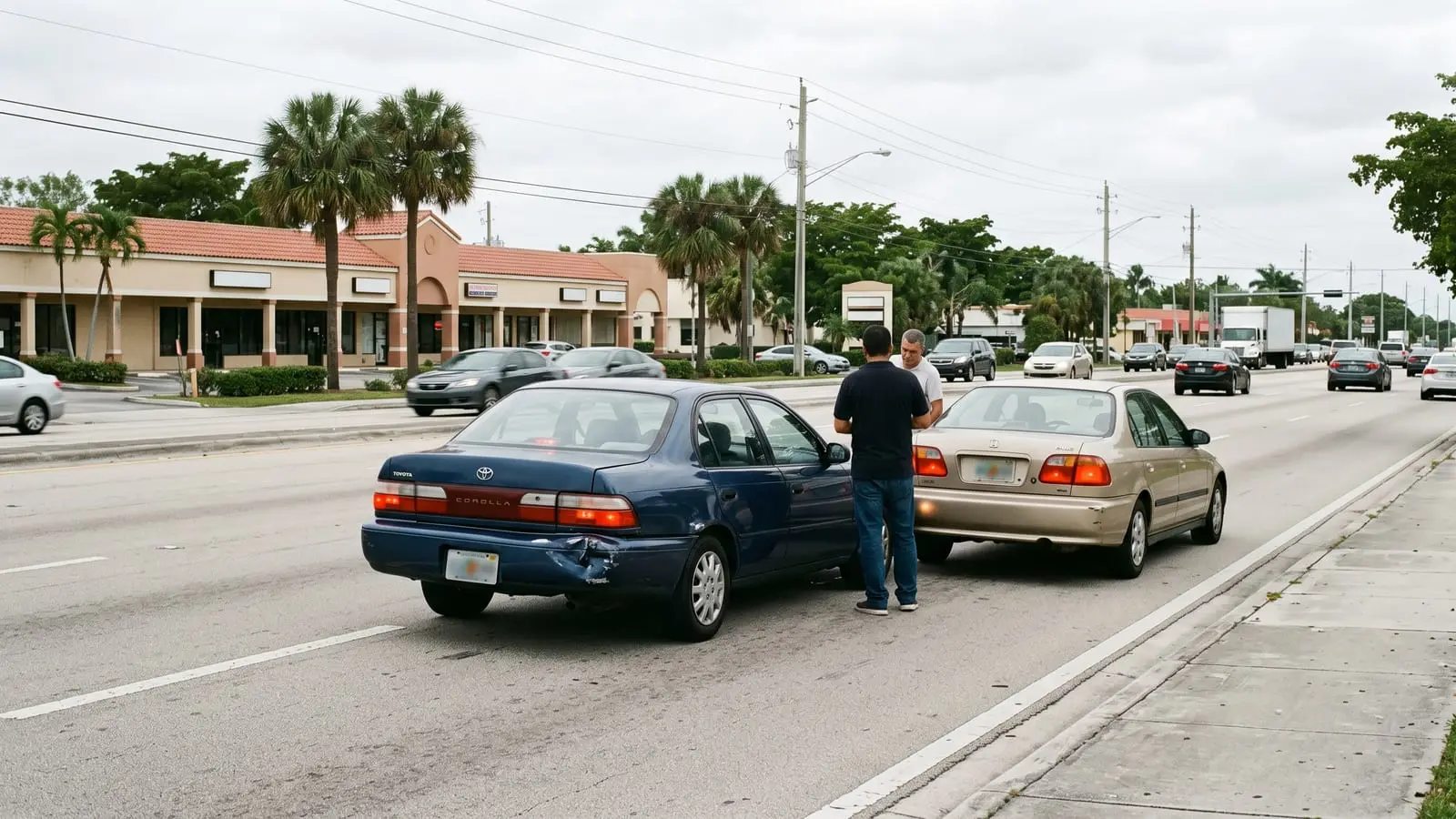
Hit by a tourist, a snowbird or a rental car in Fort Myers: whose insurance pays?
If you live in Florida and were hurt by an out-of-state driver in Fort Myers, your own PIP coverage pays your first medical bills and lost wages, wherever the other driver lives (Fla. Stat. § 627.736). After PIP, the claim goes to the visitor's own auto liability policy, which normally travels with the driver into Florida. If the visitor was in a rental car, the Graves Amendment, a federal statute (49 U.S.C. § 30106), usually keeps the rental company itself out of the case unless the company was negligent, and when the visitor's coverage is missing or too small, your uninsured motorist coverage fills the gap (Fla. Stat. § 627.727).
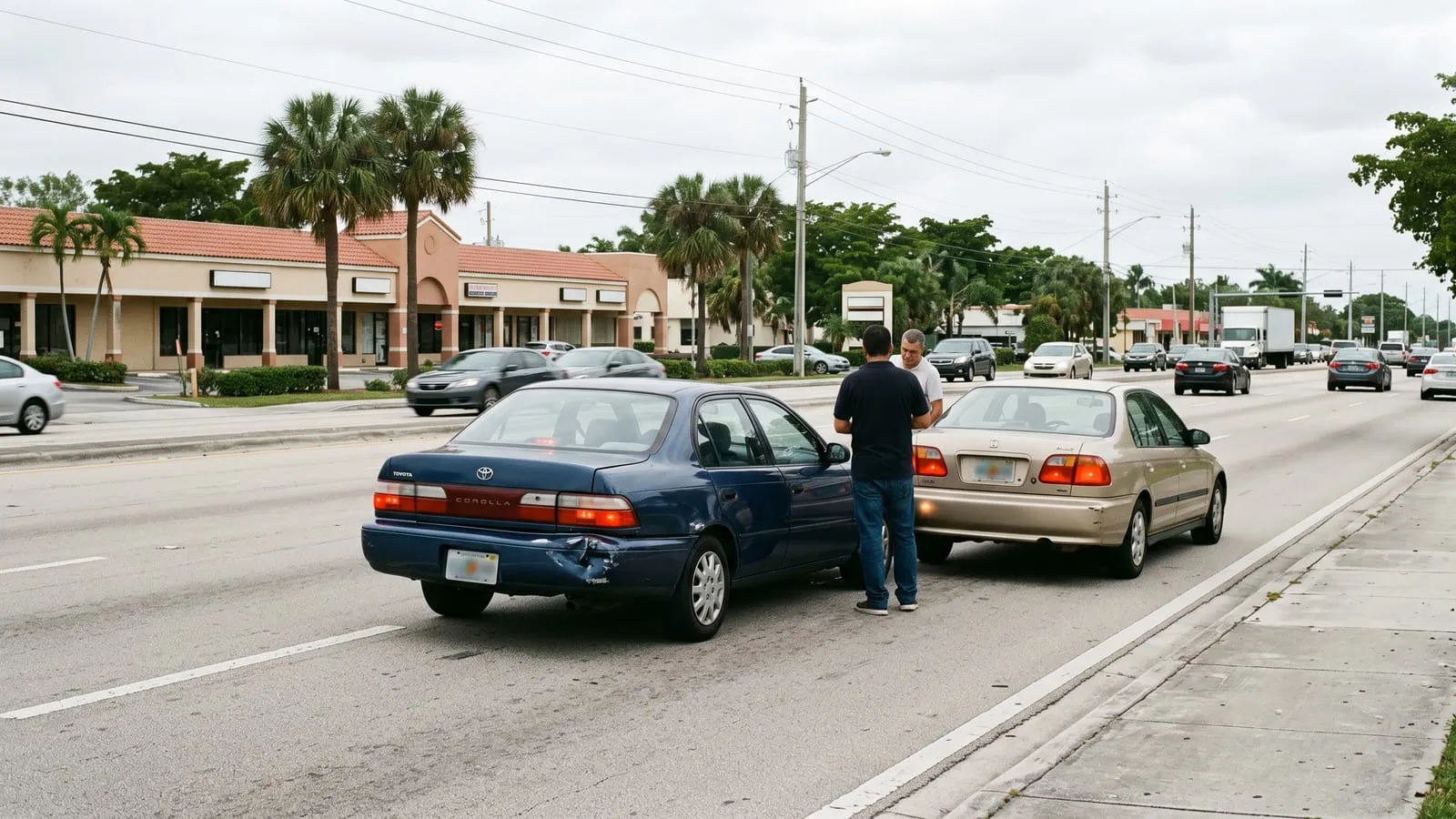
From January through April, a large share of the traffic on US 41, Summerlin Road, McGregor Boulevard and the roads out to Fort Myers Beach and Sanibel belongs to people who do not live here year-round: seasonal residents back for the winter, families in town for spring training at JetBlue Park or Hammond Stadium, and visitors who picked up a rental car at Southwest Florida International Airport an hour earlier. After a collision with one of them, the first question every injured person in Lee County asks is the same: whose insurance is responsible for this?
The short version is that the answer comes in layers, and the first layer is yours.
Does my own PIP pay if the other driver lives in another state?
Yes. If you are a Florida resident with a car, your Personal Injury Protection (PIP) is the first coverage to pay, and neither fault nor the other car’s home state changes that (Fla. Stat. § 627.736). Within its $10,000 limit it covers 60% of lost income and 80% of reasonable medical charges, and it requires that your first treatment happen within 14 days of the crash. The other driver’s home state has nothing to do with that part of the claim.
Even without a car of your own, PIP can still reach you through a relative you live with. And if you were walking or on a bicycle, a separate order of PIP coverage applies, which we explain in pedestrian and bicycle crashes in Fort Myers and Cape Coral.
Does a seasonal resident have to carry Florida insurance?
Sometimes. Under Fla. Stat. § 627.733, a nonresident whose car has been physically in Florida for more than 90 days during the preceding 365 days must carry Florida security: the same PIP and property damage coverage a resident needs. A snowbird who keeps a car in Lee County from November to April usually crosses that line. A visitor on a two-week trip does not.
Why this matters to you: if the seasonal driver who hit you bought a Florida policy, the claim runs through a Florida insurer under Florida rules. If the driver kept only a policy from Ohio, New York or Ontario, the claim runs through that policy instead, and we need its full wording.
Whose liability coverage pays for the rest of my injuries?
After PIP, you look to the at-fault driver’s liability policy for the medical bills and wages PIP left unpaid and, if the injury qualifies, for pain and suffering. Auto liability coverage generally follows the driver and the car across state lines, so a visitor’s policy from home is usually the one that answers.
That can work in your favor. Here in Florida, bodily injury liability is optional for most drivers; registering a car takes only PIP and property damage liability (Fla. Stat. §§ 627.733, 324.022). Most other states do require bodily injury coverage, so a visiting driver often has some, where a local driver might have none. Many policies issued elsewhere also contain a clause that raises coverage to meet the minimums of the state where a crash happens. Whether a particular policy helps depends on its exact language, which is why we request the declarations page and the policy itself, not just a summary from the adjuster.
Pain and suffering still requires an injury that meets Florida’s permanency threshold in Fla. Stat. § 627.737(2), because the crash happened here.
Who pays when the driver was in a rental car?
Rental cars from RSW are everywhere in Lee County in season, and they come with their own set of rules. In the usual order:
- The renter’s own auto policy. Most personal policies extend liability coverage to a car the policyholder rents. For a visitor, that is the home-state policy.
- Supplemental liability insurance bought at the counter. If the renter bought it, it can add a meaningful layer above the renter’s own coverage. The rental agreement shows whether it was purchased.
- An employer’s policy. If the renter was traveling for work, the employer’s commercial coverage may apply.
- The rental company itself, only in narrow cases. Florida law ordinarily holds a vehicle’s owner responsible for how others drive it, but it limits that rule for leasing companies (see Fla. Stat. § 324.021(9)(b)), and the Graves Amendment, a federal statute (49 U.S.C. § 30106), generally protects a rental business from liability based only on owning the car. The protection ends where the company’s own negligence begins, for example renting out a car with bad brakes or an open safety recall.
One thing that rarely helps an injured person: the coverage that comes with a credit card. It is usually written to cover damage to the rental car, not injuries to other people.
What if the visitor’s coverage is too small, or there is none?
Then your own uninsured motorist (UM) coverage becomes the most important policy in the case. Under Fla. Stat. § 627.727, UM takes the place of the liability coverage the at-fault driver lacked, or tops up coverage that was too thin for your injuries. Florida drivers can decline it, so check your declarations page; if you have it, and especially if it is stacked across more than one car in your household, it may be larger than the visitor’s policy. A relative you live with may also have UM that covers you.
What should I collect at the scene when the plates are from somewhere else?
Visitors leave. Get what you need before they do:
- A photo of the driver’s license, front and back, showing the home address.
- A photo of the insurance card, plus the name of the insurer and the policy number.
- Where the driver is staying in Lee County (a condo on Fort Myers Beach, a hotel near the airport, a relative’s home in Cape Coral) and a working cell number.
- For a rental: the rental company’s name, the agreement if it is in the car, and a photo of the windshield or door sticker with the fleet number.
- Photos of the plates on every vehicle and of the damage.
- Names and numbers of witnesses, and the report number from the officer.
Can I sue a driver who already went home?
Yes. A crash in Lee County can be litigated in Lee County, in the Twentieth Judicial Circuit at the Lee County Justice Center on Monroe Street, even after the driver has flown home. In practice, the at-fault driver’s insurer hires local defense counsel and the driver rarely needs to return except for a deposition or trial. For crashes on March 24, 2023 or later, Florida’s deadline to file a negligence suit is two years (Fla. Stat. § 95.11), and an out-of-state insurer is held to the same deadline as a local one.
How Wolfson & Leon handles a claim against an out-of-state driver
Out-of-state claims usually stall on paperwork: the wrong insurer, an adjuster in another time zone, a rental agreement no one has requested. When you call our Fort Myers office at 239-309-1392, we identify every policy that might apply, yours and the visitor’s, send coverage requests to each insurer, and get the rental agreement when there is one. Then we put the policies in order so PIP, the visitor’s liability coverage and your UM each pay what they owe. Talking with us costs nothing, we work in English and Spanish, and our fee comes only out of money we recover for you. See our car accident practice and, if the driver never stopped, our guide to a hit-and-run in Lee County.
Key facts
- A Florida resident's own PIP pays first after a crash, no matter where the at-fault driver is from. Source: Fla. Stat. § 627.736
- A nonresident whose vehicle has been in Florida for more than 90 days in the past 365 must carry Florida PIP and property damage security. Source: Fla. Stat. § 627.733
- To register a car, most Florida drivers need just two coverages, PIP and property damage liability; bodily injury liability is optional. Source: Fla. Stat. §§ 627.733, 324.022
- The federal Graves Amendment generally shields a rental company from liability based only on owning the car, but not from its own negligence. Source: 49 U.S.C. § 30106
- Florida separately limits the liability of vehicle lessors under its owner-liability rules. Source: Fla. Stat. § 324.021(9)(b)
- UM coverage stands in for the at-fault driver's liability policy when that policy is missing or smaller than the harm it caused. Source: Fla. Stat. § 627.727
Frequently asked questions
The driver who hit me went back to Michigan. Can I still bring a claim here?
Yes. The claim is made against the driver's insurance company, which handles it whether the driver is in Fort Myers or not. If a lawsuit is needed, it is normally filed in Lee County, where the crash happened, in the Twentieth Judicial Circuit at the Lee County Justice Center.
I am the visitor. Does Florida PIP cover me?
It depends on your home policy. Many policies from other states include personal injury protection or medical payments coverage that applies on a Florida trip, and some adjust automatically to Florida's requirements. Read the declarations page and call us if the insurer says you have nothing.
The rental company's adjuster called me first. Should I talk to them?
You can take down their information, but hold off on any recorded statement or signature until it is clear which policy is primary. The rental company may not be the insurer that actually owes your claim, and what you say can be used by every insurer involved.
What if the out-of-state driver had no insurance at all?
Your PIP still pays first. After that, your uninsured motorist coverage, or the UM coverage of a relative you live with, steps in for the at-fault driver. If no one in the household has UM, recovery beyond PIP depends on the driver's own assets, which is often not realistic.
Wolfson & Leon publishes this article as general information about Florida injury law. It is not legal advice for your situation, and reading it or contacting us through this page does not form an attorney-client relationship. Each claim turns on its own facts, and prior results do not guarantee a similar outcome in any other matter. If you were injured, speak with a lawyer about your own case.
Also available in: Versión en español