
I was hit by a truck in Fort Myers. What makes a truck case different?
A truck case differs from a car case in three ways: stricter rules, larger insurance policies, and evidence that vanishes quickly. Drivers and carriers must follow the Federal Motor Carrier Safety Regulations (49 C.F.R. Parts 390–399), which Florida enforces on its own roads through Fla. Stat. § 316.302; interstate freight haulers must be insured for at least $750,000; and a truck's camera video and electronic data can be wiped within days unless someone formally demands that the company keep them.
Wolfson & Leon's office on Cleveland Avenue handles truck injury claims across Lee County and neighboring Collier County, and the firm has stood up for injured people since 1963. Your first meeting costs nothing, we work in English and Spanish, and the firm charges a fee only if it collects compensation on your behalf.
What kinds of trucks cause crashes around Fort Myers?
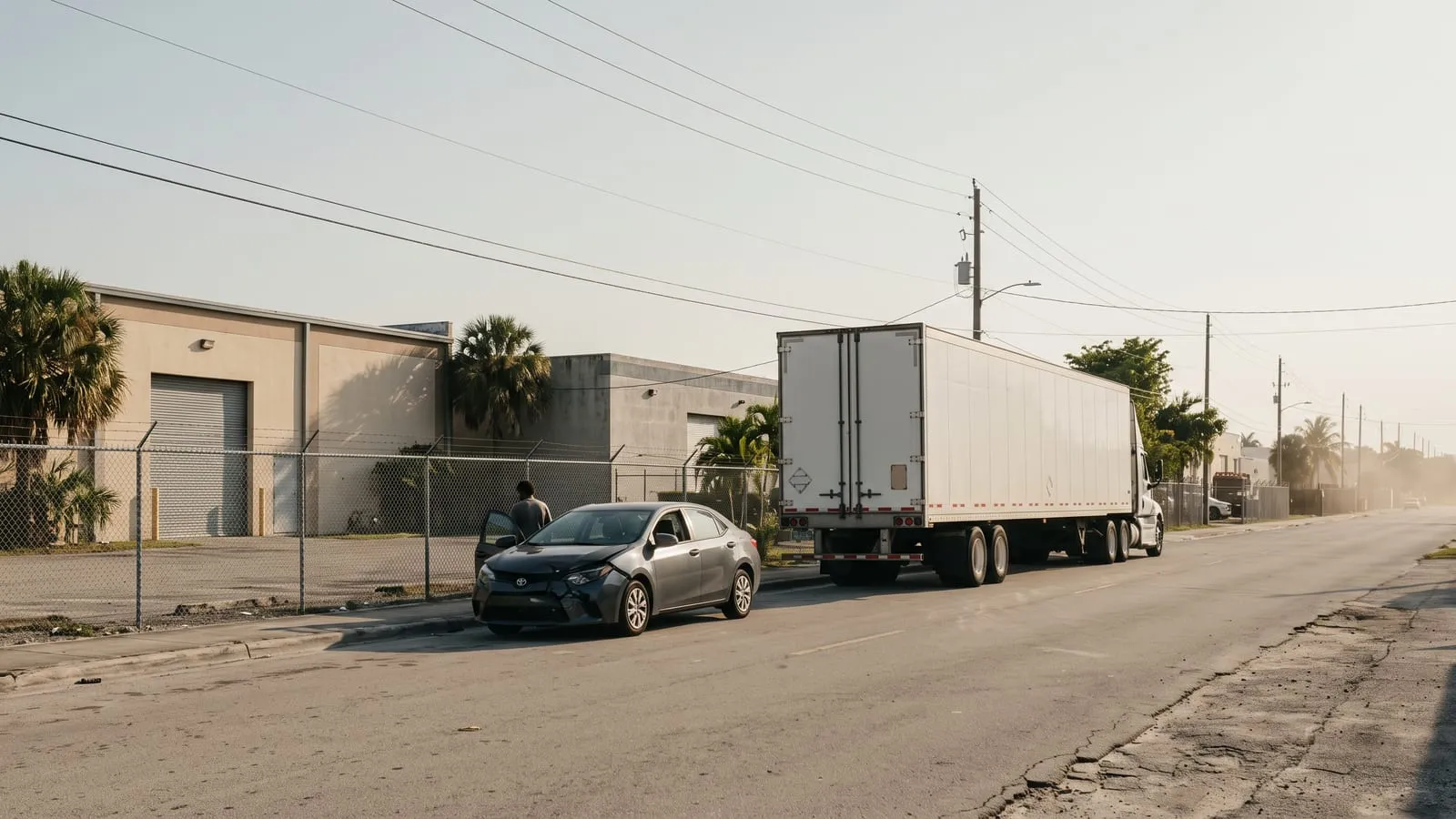
Lee County has an unusual mix of heavy traffic. Long-haul tractor-trailers run I-75 between Tampa and Naples and get off at Colonial Boulevard, Daniels Parkway, Alico Road, and Palm Beach Boulevard to reach the warehouses and industrial parks near the airport and along Alico Road. East of town, Palm Beach Boulevard (SR 80) and SR 82 toward Immokalee carry citrus and vegetable haulers, sod and fertilizer trucks, and dump trucks loaded with fill and rock.
Then there is the rebuilding. Ever since Hurricane Ian came ashore in September 2022, roofing trucks, debris haulers, concrete mixers, and flatbeds stacked with trusses and block have crowded residential streets on Fort Myers Beach, in Cape Coral, on Pine Island, and on Sanibel. Add the box trucks and delivery vans working every subdivision in Lehigh Acres and Estero, and very few roads in the county are free of commercial vehicles.
Who can be held responsible for a truck crash?
Usually more than the driver. Walk through each link in the chain: the person behind the wheel (speeding, phone use, fatigue, a lane change without a mirror check); the motor carrier that hired, trained, and dispatched that person; whoever owns the tractor or the trailer, which may not be the carrier at all; the company that loaded the cargo, since an unbalanced or loosely strapped load of block, sod, or roofing material can tip a truck or spill across a lane; and the shop that last touched the brakes or tires. Any of them can be a separate defendant carrying a separate policy.
Florida's dangerous instrumentality doctrine opens one more path: a vehicle's owner can be liable for the harm it does while someone else drives it with permission. That comes up constantly in Southwest Florida construction, where a roofing subcontractor may be driving a truck titled to a general contractor or rented from an equipment yard.
How quickly does truck evidence disappear?
Sooner than most people expect. Federal rules make a carrier keep six months of electronic logging device data (49 C.F.R. § 395.8). Even so, road-facing and cab-facing camera footage, GPS pings, and the engine's event data recorder can be recorded over within days or weeks. Many carriers also send their own rapid-response investigators to the scene within hours.
As soon as you hire Wolfson & Leon, we put the carrier and its insurer on written notice to preserve the proof: driver logs, camera video, dispatch and delivery records, inspection and repair files, post-crash drug and alcohol results, and the driver qualification file. On local routes we also hunt for traffic cameras, security video from businesses along US 41 and Colonial Boulevard, and witnesses before they move on. A lawyer who first hears about the crash a month later may find much of that already gone.
Which trucking safety rules come up most in Lee County cases?
Florida applies the federal motor carrier safety rules to commercial vehicles on its roads (Fla. Stat. § 316.302), with some state adjustments for trucks that never cross the state line. Four parts of those rules decide a large share of cases, and breaking any of them is powerful proof of negligence:
- Driving-hour limits, 49 C.F.R. Part 395. Once a driver has had 10 hours off duty, the limit is 11 hours behind the wheel. An exhausted driver near the end of a long run down I-75 is a familiar story.
- Driver qualification (Part 391). The carrier has to check each driver's license, driving history, and medical fitness and keep a file showing it did.
- Inspection, repair, and maintenance (Part 396). Brakes, tires, lights, and coupling devices must be inspected and kept in safe working order.
- Drug and alcohol testing (Part 382). Commercial drivers are subject to testing, including after many serious crashes.
How much insurance does a commercial truck carry?
A carrier moving general freight across state lines needs at least $750,000 in liability coverage, and hazardous-materials carriers need between $1,000,000 and $5,000,000 depending on the cargo (49 C.F.R. § 387.9). Trucks that work only inside Florida, like many local dump and farm trucks, fall under separate state minimums that rise with the truck's weight (Fla. Stat. § 627.7415), and plenty of companies buy more than the minimum.
Compare that with an ordinary Florida car, which does not have to carry bodily injury coverage at all. A large policy is good news for the person who was hurt, but it also means the insurer puts adjusters and defense lawyers on the file almost at once. It makes sense to have someone working for you from the start as well.
What can I be compensated for after a truck crash in Lee County?
You can claim the same kinds of loss as in any Florida crash: past and future medical care, lost wages and lost earning capacity, and pain and suffering when the injury is permanent. What changes in a truck case is the severity of the injuries and the number of insurers. The driver, the carrier, the owners of the tractor and trailer, the loader, and the repair shop may each have a policy, and interstate carriers start at $750,000 in required coverage (49 C.F.R. § 387.9). We map every party and every policy before putting a number on your claim, because a case measured against one policy when several apply is underpriced from day one.
What mistakes can weaken a truck accident claim?
- Waiting weeks to get help. Camera footage and engine data can be recorded over quickly, so the preservation demand needs to go out right away.
- Giving a statement to the carrier's adjuster or investigator. They often appear at the scene or phone the next morning, and their job is to protect the company.
- Letting your vehicle be repaired or hauled to salvage before it is photographed and, after a serious crash, examined by an expert.
- Naming only the company painted on the door. In Southwest Florida trucking and construction, the driver, tractor, trailer, and cargo frequently belong to different businesses.
- Settling early with one party without knowing how that release affects your claims against the rest.
- Posting about the crash or your recovery online. Insurers look, and a single beach photo can be framed as proof you were not really hurt.
Key facts
- $750,000 is the minimum liability coverage for interstate carriers hauling general freight. Source: 49 C.F.R. § 387.9
- Driving time is capped at 11 hours following 10 straight hours off duty. Source: 49 C.F.R. § 395.3
- The carrier must retain electronic logging records for six months. Source: 49 C.F.R. § 395.8(k)
- Federal motor carrier safety regulations govern commercial vehicles operating on Florida roads. Source: Fla. Stat. § 316.302
- Crashes from March 24, 2023 onward: in most cases, two years to file a negligence suit. Source: Fla. Stat. § 95.11
- An injured person found more than 50% at fault recovers no damages. Source: Fla. Stat. § 768.81(6)
- A written notice of claim is required before suing a government agency, such as Lee County or FDOT, over a crash involving its truck. Source: Fla. Stat. § 768.28(6)
Frequently asked questions
The trucking company's insurer called with an offer. Should I accept it?
Not yet. A fast offer usually comes before anyone knows whether you will need surgery, more therapy, or time away from work, and before every policy has been found. Signing a release ends the claim for good, so talk it through in a free consultation and compare the offer with what the case may really involve.
The truck had out-of-state plates. Does that change anything?
It can. A carrier hauling freight between states is bound by the federal safety rules and federal insurance minimums, and a lawsuit against it may be heard in federal court, at the Middle District of Florida's Fort Myers Division on First Street downtown, instead of the Lee County Justice Center on Monroe Street. Our lawyers appear in both state and federal court in Florida.
The driver says he is an independent contractor. Is the company off the hook?
Not necessarily. Federal leasing regulations and Florida law generally make the carrier whose USDOT number appears on the truck responsible for how the driver operates it while hauling under that carrier's authority. Contractor labels are common in trucking and construction, and they seldom settle the question.
A county debris truck or city vehicle hit me. Can I still make a claim?
Yes, but the steps change. If the truck belonged to Lee County, the City of Fort Myers, the City of Cape Coral, or FDOT, the law demands formal notice to the agency first (Fla. Stat. § 768.28(6)), and recoveries against government agencies are limited. Many debris and roadwork trucks are run by private contractors instead, which are usually treated like any other business, so identifying the real owner is one of the first things we do.
How long will my truck accident case take?
Longer than most car cases. With several defendants, more records to collect, and bigger policies at stake, a case that goes into litigation commonly runs one to three years. We give you a realistic timeline at the outset and keep you updated as it moves.
What happens when you call
A real person picks up
Call 239-309-1392 at any hour. Someone from the firm answers, in Spanish if you like. Late at night, we take your information and an attorney calls you early the next morning.
About 15 minutes on what happened
We ask when and where it happened, what medical care you have had, whether police wrote a report, and whether an insurer has contacted you. You do not need any documents handy.
An honest answer
If yours is a case we can take, we explain what comes next and what to avoid in the meantime. If it is not, we tell you plainly and point you to who else might help.
Nothing up front if you hire us
We take a percentage of any money recovered, and that is put in writing before you sign. No recovery, no fee. If getting to the office is hard, we will come to where you are, whether that is home or a hospital bed.
We have not written about this topic yet. Give us a call and an attorney will answer your question.