
Hit while walking or biking in Fort Myers or Cape Coral: your rights, even without a car
A pedestrian or cyclist struck in Fort Myers or Cape Coral who owns no car can usually still get Florida PIP for the first medical bills: it comes from the auto policy of a relative in the same household, and when no one at home has a policy, from the PIP on the car involved (Fla. Stat. § 627.736(4)(e)), provided the injured person makes a home in Florida. You still need treatment within 14 days. Crossing outside a crosswalk or riding without a light does not end your claim against the driver; under Fla. Stat. § 768.81(6), your share of fault reduces what you recover and cuts it off completely only above the 50% line.
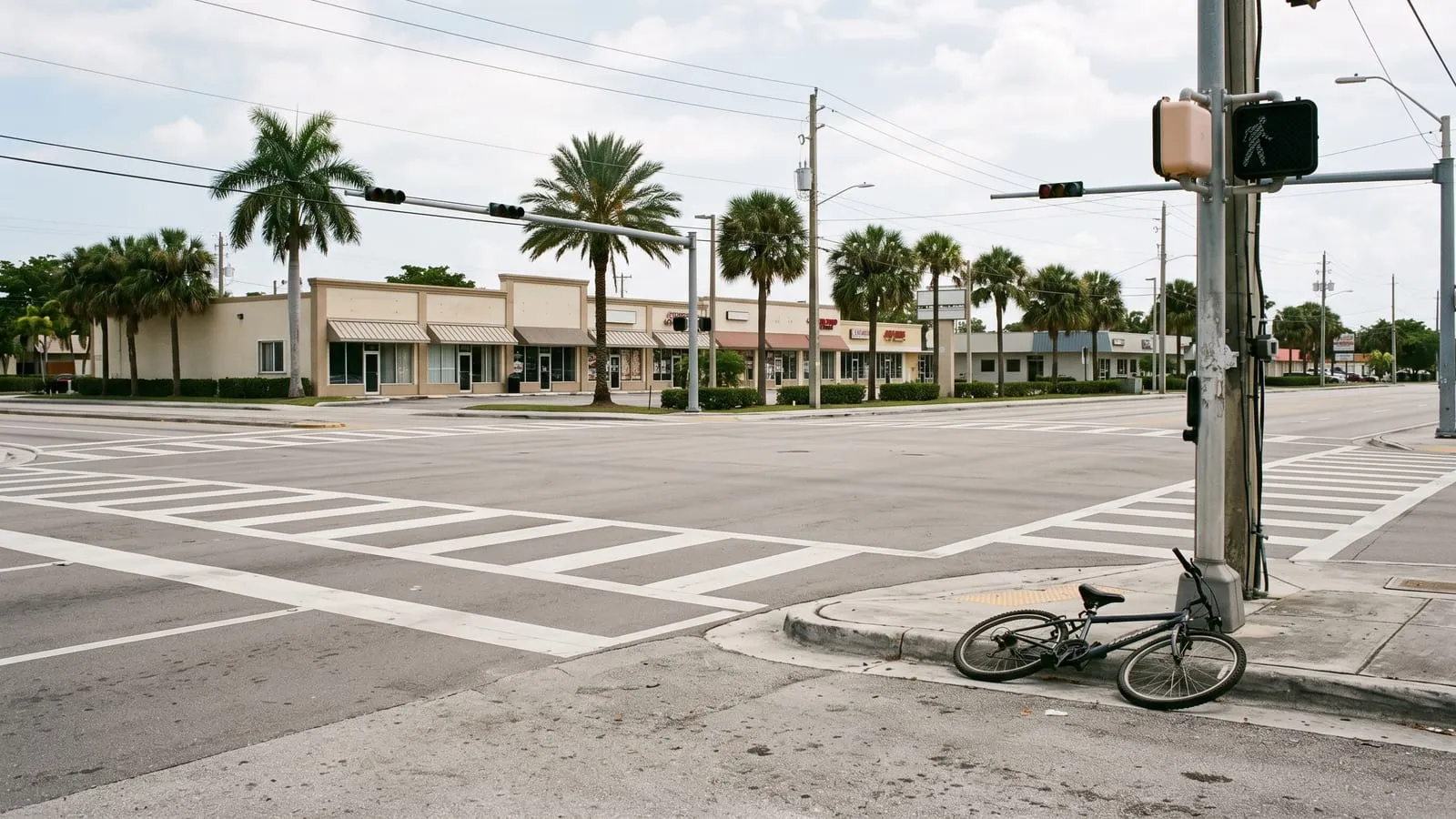
Lee County was built around the car. Cleveland Avenue, Colonial Boulevard, Palm Beach Boulevard and Six Mile Cypress run six lanes wide with long gaps between signals, and in Cape Coral and Lehigh Acres the same pattern repeats on Del Prado, Santa Barbara, Veterans and Lee Boulevard. Plenty of people still walk and ride here: to LeeTran stops, to early shifts at job sites and nurseries, to school, or for exercise along McGregor and Summerlin. When a car hits one of them, the person on foot or on the bike often has no car of their own and assumes no insurance will help. That assumption is usually wrong.
Does PIP cover a pedestrian or cyclist who doesn’t own a car?
In most cases, yes. Florida’s Personal Injury Protection is tied to people as well as cars, and Fla. Stat. § 627.736(4)(e) sets the order in which it pays a person struck while walking or cycling:
- A policy in your own name, if you have a car insured in Florida.
- A household relative’s policy, for example a spouse, parent or grown child under the same roof who insures a car in Florida.
- The striking car’s PIP, when nobody at home has a policy, and only for Florida residents.
PIP pays 60% of lost wages and 80% of reasonable medical bills, with a $10,000 limit, or $2,500 if no qualifying provider finds an emergency medical condition. And like every PIP claim, it pays only if you are first seen by a qualifying provider inside the 14-day window in Fla. Stat. § 627.736(1)(a). An ambulance ride to Lee Memorial or Gulf Coast Medical Center satisfies it. If you went home bruised, get seen now.
What if the driver had no insurance or drove away?
Uninsured motorist (UM) coverage follows the person, not just the car. If anyone in your household, you included, carries UM on a Florida auto policy, it can pay for your injuries as a pedestrian or cyclist when the driver had no bodily injury coverage, had too little, or fled and was never identified (Fla. Stat. § 627.727). Many families in Lehigh Acres and Fort Myers have UM on a household car without knowing it. We ask to see every policy in the home. If the driver left the scene, read our guide to a hit-and-run in Lee County.
I crossed outside the crosswalk. Can I still recover?
Usually, yes. Florida law does tell a pedestrian who crosses anywhere other than a marked crosswalk or an intersection to yield to vehicles (Fla. Stat. § 316.130(10)). The same statute puts an independent duty on drivers: exercise due care so they do not strike a person on foot (Fla. Stat. § 316.130(15)). A driver who was speeding, looking at a phone, or turning without checking the crosswalk cannot hide behind the fact that you were mid-block.
The result is a division of blame. A jury gives each side a percentage, as Fla. Stat. § 768.81(6) directs. If your share is 30%, your damages are reduced by 30%. Only if your share is found to be greater than 50% do you recover nothing. On a road like Palm Beach Boulevard, where the next signal can be a long walk away and the bus stop sits on the far side, juries understand why people cross where they do.
What about cyclists riding at night or on the sidewalk?
Florida’s bicycle rules are in Fla. Stat. § 316.2065. Two come up in nearly every case:
- Lights after dark. A bicycle ridden between sunset and sunrise needs a white light on the front and a red light and reflector on the back. Riding to a 5 a.m. shift without them will be argued as shared fault.
- Sidewalk riding. Riding on the sidewalk is generally allowed, but a cyclist there must yield to people walking and give an audible signal before passing them.
Neither rule ends a claim. They become part of the fault percentages, which is why the evidence about lighting, speed and the driver’s attention matters so much.
What evidence should be saved in the first days?
Pedestrian and bicycle cases depend on details that disappear quickly:
- Video. Gas stations, restaurants and shopping centers along US 41 and Colonial keep camera footage for a limited time. If a LeeTran bus passed or was stopped nearby, its cameras may have recorded the crash.
- The scene. Photos of the crosswalk or the spot where you were crossing, the streetlights (and whether they were working), the signal and any obstructions such as parked trucks or overgrown landscaping.
- Your clothing, shoes and bike. Do not wash, repair or throw them out. Damage to the bike shows the angle and force of the impact.
- Your own data. A fitness app, a bike computer or phone location history can show your route and speed.
- The crash report. Ask the responding officer, whether Fort Myers Police, Cape Coral Police, the Lee County Sheriff’s Office or FHP, for the report number. During the first 60 days the report is released only to the people involved and their insurers and lawyers (Fla. Stat. § 316.066).
What if a LeeTran bus, a school bus or a city truck hit me?
Claims against government vehicles follow special rules. Before you can sue Lee County, the City of Fort Myers, the City of Cape Coral or the Lee County School District, written notice of the claim must be presented to the agency (and, for some agencies, to the Florida Department of Financial Services as well), and a waiting period follows before any lawsuit (Fla. Stat. § 768.28(6)). Damages against government defendants are also capped by statute. Do not let the notice deadline slip while you are still in treatment.
Can I recover pain and suffering, and how long do I have?
PIP never pays for pain and suffering. The driver’s insurer owes it only for an injury that clears Florida’s tort threshold, Fla. Stat. § 627.737(2): an injury that is permanent, scarring or disfigurement that is significant and permanent, or the significant and permanent loss of an important bodily function. Pedestrians and cyclists often meet it, because the body takes the whole impact. For crashes since March 24, 2023, the suit must be filed within two years (Fla. Stat. § 95.11).
How Wolfson & Leon helps after a pedestrian or bicycle crash
When you call our Fort Myers office at 239-309-1392, we find every PIP and UM policy in your household, identify the driver’s insurer, and send preservation requests for nearby video within days. Past results from this office include a $650,000 pedestrian accident recovery; prior results do not guarantee a similar outcome. Talking with us costs nothing, we work in English and Spanish, and our fee comes only out of money we recover for you. Read more about our pedestrian and bicycle accident practice.
Key facts
- Someone struck on foot or on a bike draws PIP in a fixed sequence: a policy in their own name, next a household relative's, and last, for Florida residents, the policy on the car involved. Source: Fla. Stat. § 627.736(4)(e)
- PIP requires a first medical visit within 14 days and pays, up to $10,000, 60% of lost wages and 80% of reasonable medical expenses. Source: Fla. Stat. § 627.736(1)
- A pedestrian crossing outside a marked crosswalk must yield to vehicles, but drivers keep a separate duty to use due care to avoid hitting anyone. Source: Fla. Stat. § 316.130
- Bicycles ridden after dark need a white front lamp and a red rear lamp and reflector. Source: Fla. Stat. § 316.2065
- An injured person found to bear more than half the fault recovers nothing; at half or less, damages shrink by that share. Source: Fla. Stat. § 768.81(6)
- A claim against a government vehicle, such as a county bus, cannot go to court until the agency has received the claim in writing. Source: Fla. Stat. § 768.28(6)
Frequently asked questions
I don't have a car or a license. Can PIP really cover me?
Often, yes. A Florida auto policy held by a family member in your household extends its PIP to you. With no policy at home, the PIP carried on the striking car can apply, provided Florida is your state of residence. You do not need a license to be covered as a pedestrian or cyclist.
I was riding my bike to work before sunrise without a light. Do I still have a case?
Probably, though the missing light will be argued as shared fault. Florida requires a front white light and rear red light and reflector after dark, and the driver's insurer will raise it. That can lower the award by whatever share of blame is assigned to you, but the driver still had to watch the road.
The driver says I came out of nowhere. Who will the police believe?
The report records what the officer saw and was told, but it does not decide the civil case. Video from nearby businesses and buses, the location of debris and of your shoes or bike, the vehicle's damage, and the lighting at that spot often show what really happened.
I was hit in a shopping center parking lot, not on the road. Does PIP still apply?
Yes. PIP applies to a pedestrian struck by a motor vehicle in a parking lot just as on a street. The property owner may also share responsibility if poor lighting, missing stop signs or a confusing layout played a role.
Wolfson & Leon publishes this article as general information about Florida injury law. It is not legal advice for your situation, and reading it or contacting us through this page does not form an attorney-client relationship. Each claim turns on its own facts, and prior results do not guarantee a similar outcome in any other matter. If you were injured, speak with a lawyer about your own case.
Also available in: Versión en español